How Is Primativism an Important Factor in Evolution of Modern Art
Primitivism fine art, a complicated and frequently paradoxical tendency, brought in a new ways of viewing and exploiting forms of and so-called primitive artwork, and had a meaning office in dramatically shifting the course of American and European art at the beginning of the 20th century. Primitivism in art wasn't really a school as it was a tendency amongst varied gimmicky artists from many nations who were seeking to the past and foreign cultures for fresh artful materials as urbanization and industrialization increased. Starting around the 19th century, the flow of African, Oceanian, and Native American tribal artworks into Europe provided Primitivist painters with a new visual language to develop. Primitive paintings, in many respects, gave artists a platform to criticize the staid conventions of European art.
Table of Contents
- ane An Exploration of Primitive Artworks
- 1.1 Primitivism Definition and Ideals
- 2 The Origins of Primitivism Fine art
- 2.one The Emergence of the Noble Savage
- 2.two Primitivism in Art Towards the Close of the 19th Century
- ii.iii Primitive Artwork in the Early on 20th Century
- 3 Primitivism Styles and Concepts
- iii.one Orientalism and Primitivism
- 3.two Naïve Fine art and Child Art
- 3.3 Neoprimitivism
- four Famous Primitive Paintings
- 4.i Vision Later on the Sermon (1888) by Paul Gauguin
- 4.two Les Demoiselles d'Avignon (1907) by Pablo Picasso
- 4.3 Bathers in a Room (1909) by Ernst Ludwig Kirchner
- 4.4 Childbirth (1944) past Jean Dubuffet
- 5 Ofttimes Asked Questions
- five.i What are Primitivism Art and Neoprimitivism Fine art?
- 5.2 How Did the Idea of the Noble Primitive Ascend?
An Exploration of Archaic Artworks
The employment of simplified forms and more bathetic figures in Primitivism art diverged dramatically from conventional European ways of depiction, and gimmicky artists similar Picasso, Gauguin, and Matisse revolutionized visual arts using these forms.
While Primitivism in art appeared to exist an endeavor to integrate and drag indigenous traditions, it was an essentially Eurocentric undertaking that, in many instances, was prejudiced against the very traditions it stole.
Throughout the late 20th and early on 21st centuries, artists and researchers worked to properly contextualize Primitivist artworks and highlight their flaws every bit a model for comprehending fine art from non-European civilizations.
Primitivism Definition and Ideals
Primitive artwork, as perceived by modern painters, not just gave new visual forms, but also a richer and more comprehensive spiritual and emotional template that the artists used to criticize the industrialization of Western civilization.
Archaic paintings, laden with nostalgia, sought links to a pre-industrialized period in which individuals were more linked with the environment and one other.
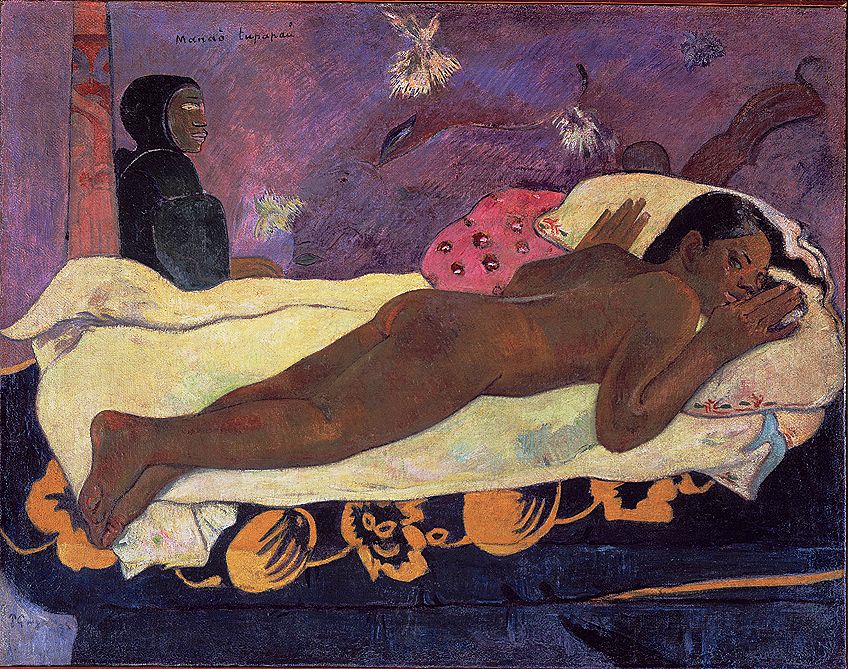 The Spirit of the Dead Keeps Watch(1892) by Paul Gaugin, an instance of artwork that drew from primitivism; Paul Gauguin, Public domain, via Wikimedia Commons
The long-lasting legacy of Archaic paintings, as well every bit long-held ideas about the poor quality of work from colonial places, accept made information technology hard to include artists from Africa, Aborigines, and Native America in art historical narratives, simply efforts to create a universal fine art history are ongoing.
Electric current reactions to Primitivism in art, frequently past African American painters and those with a link to various African countries, are an try to examine, recover, and rethink the entirety of African history in contemporary culture, rather than just imitate the styles of tribal arts.
The Origins of Primitivism Fine art
The word "primitive" comes from Latin and means "first or oldest of its sort." Explorers of the South Pacific and Africa returned with stories of new cultures that bore piddling resemblance to what Europeans understood or cherished.
Europeans appreciated these new civilizations for their exoticism, just they as well looked down on them, because their demeanor and practices to be basically "uncivilized."
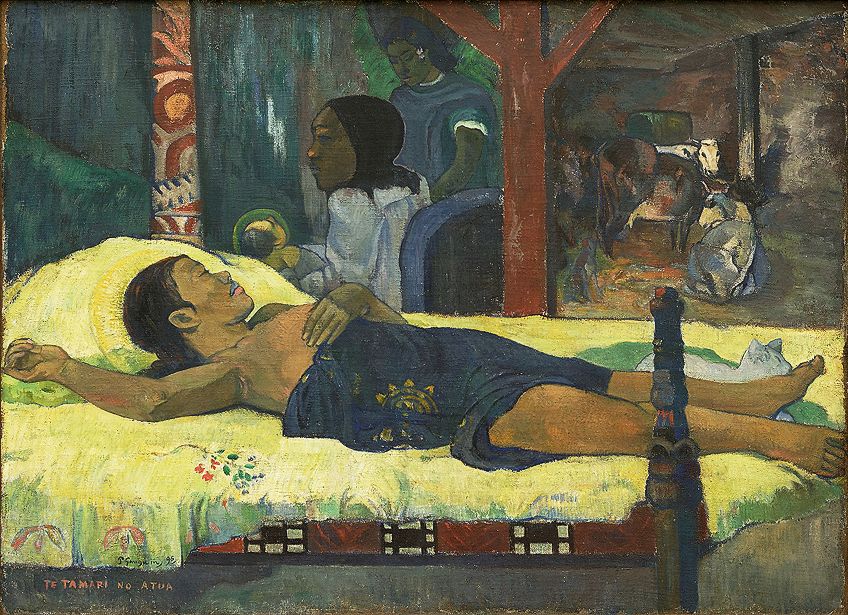 The Birth(1896) by Paul Gaugin, an case of artwork that drew from primitivism;Paul Gauguin, CC BY-SA 4.0, via Wikimedia Commons
According to art historians, the term "primitive" does not ascend without the concept of the "civilized." The 2 concepts are inherently linked and produce an ideological framework that portrays what is primitive deficient in complexity.
Nevertheless, fascination with the primitivist artform too alluded to a cornball predisposition to highlight a pre-industrial era in which ane'south relationship to nature was important.
The Emergence of the Noble Savage
The fascination with primitivist art was widespread in contemporary European society, defining a new trend in both intellectual and cultural worlds. Philosophers of the 18th century investigated the dualities between the logical and the illogical, the organic and the artificial, pushing people to rethink their ain roles in civilization.
With rapid urbanization and the emergence of industrial growth, Enlightenment authors endorsed the concept of the archaic way of life, distancing themselves from cultural and technological advancements that permitted for a more natural rhythm and balance with nature.
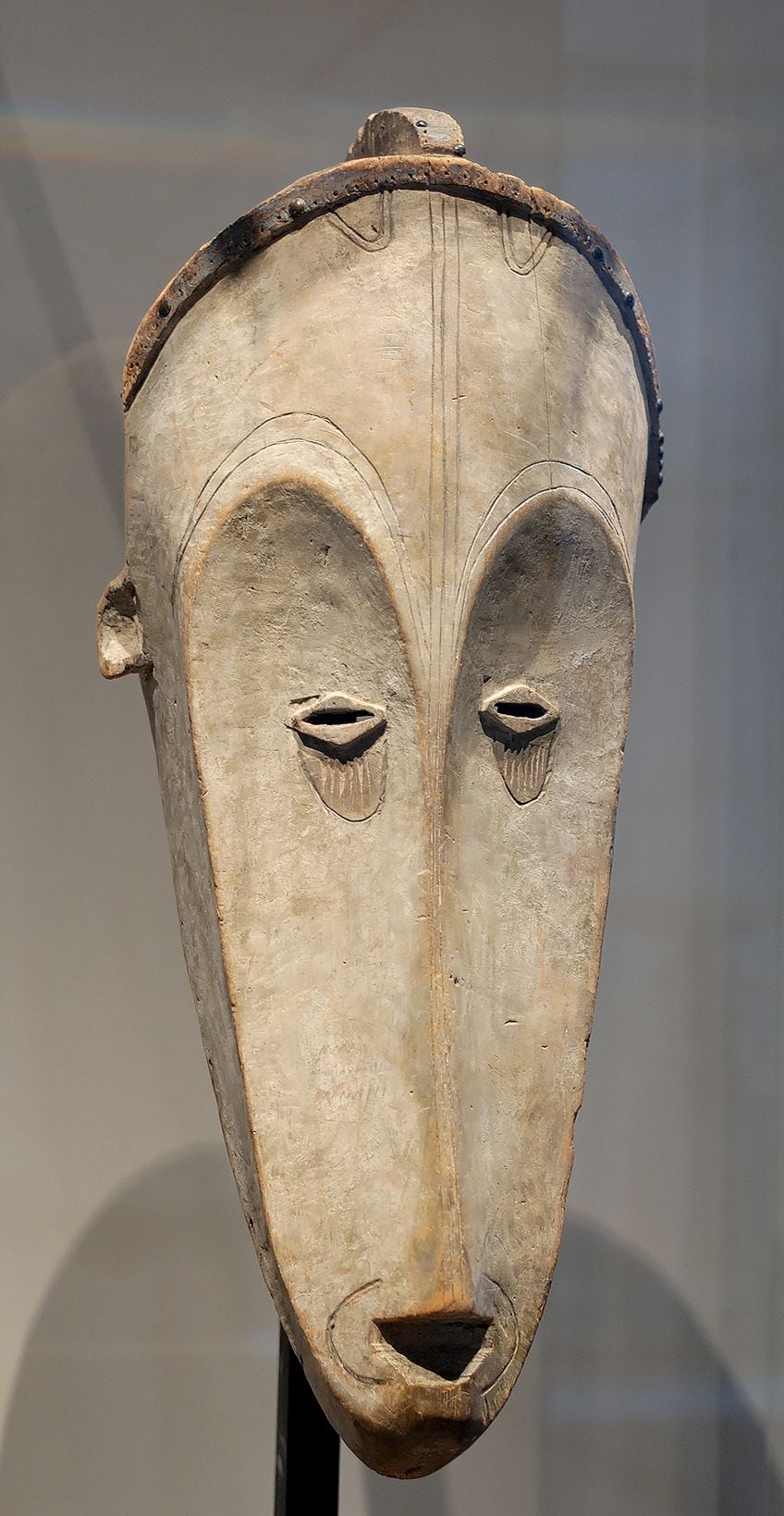 Fang mask used for thengil anniversary, an inquisitorial search for sorcerers (between the 19th and 20th centuries), located in the Louvre Museum in French republic; Musée du quai Branly, Public domain, via Wikimedia Commons
This longing for a new simplification in life was farther linked with the concept of "arcadia," portraying the archaic as a kind of lost utopia. The concept of the "noble savage" was popular during this catamenia, which many considered as a fall from earlier periods; civilisation had become corrupted, governed by persons characterized past selfishness, egoism, and a thirst for control.
The primitivist, who is said to be more in bear on with nature, was seen to be meliorate in character and kindness to the contemporary, immoral homo.
As modernity took concur, individuals, particularly artists, started to insubordinate confronting the industrialization and urbanization they witnessed. Artists began to explore other civilizations and traditions in order to counteract what they saw every bit circumscribed and stagnant Western conventions.
Primitivism in Art Towards the Close of the 19th Century
Masks and sculptures from Oceania and Africa, as well as artifacts from Native American cultures, institute their way into museums in London, Paris, and Berlin, and were shown in global fairs for the full general public to witness. The Trocadéro Museum, Paris' first ethnological museum, was established in 1878. The museum featured a variety of items from throughout the world that was supposed to be disappearing as a result of colonialism.
These artifacts, now separated from their initial historical backgrounds, were not deemed art in the European context, but for this very reason, many artists seeking characteristics and strengths that contradicted the classical, stringent academic customs decided to turn to these artifacts for motivation and verification of their own aesthetic studies.
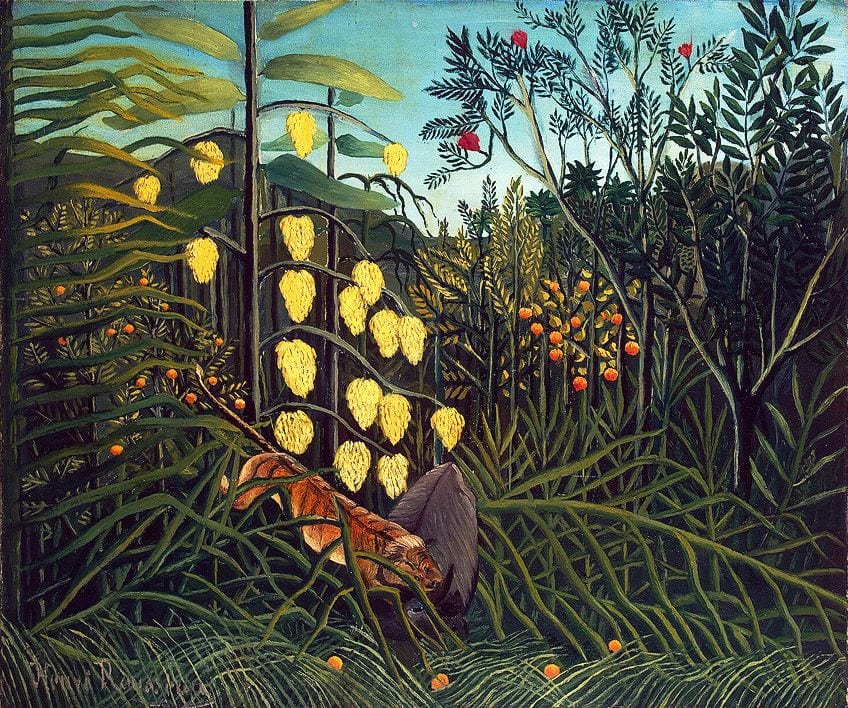 Struggle between Tiger and Bull (c. 1908 – 1909) by Henri Rousseau, an example of artwork that drew from primitivism;Henri Rousseau, Public domain, via Wikimedia Eatables
Many attribute this trend toward Primitive paintings to Paul Gauguin, who used flat decorative effects and expressionistic forms comparable to those he saw in museums and on his journeys to Hawaii and Tahiti, also as the rural region of French republic that had become widely known with painters in the mid-19th century.
Regional traditions and religious ceremonies harkened back to a simpler period, which artists and other city people yearned for. Gauguin'southward curiosity with these other civilizations collection him to push his creative experiments even farther into unconventional territory.
Dissatisfied with the Impressionists' observational technique, Gauguin and fellow Symbolists sought to transmit thoughts and feelings via lines and colors, manipulating rustic and foreign subjects.
Archaic Artwork in the Early 20th Century
Different artists, including the Fauves and a variety of German Expressionists, recognized in Primitive objects a more primal dictionary of form that was more than in accord with portraying the growing gimmicky experiences than the national academies' conventions.
Matisse purchased a tiny African figure, now recognized as a Vili figure from the Congo, in a little shop on his way to Gertrude Stein's residence in 1906, introducing his friend and competitor Picasso to primitive artwork.
Post-obit this initial interaction, Picasso started attending the Trocadéro, becoming especially enamored by the African Fang masks. His adoption and research of Primitivism's formal characteristics aspired to transform art as a whole. Picasso'due south early Cubist painting Demoiselles d'Avignon (1907) is possibly one of the most well-known instances of gimmicky art'due south borrowing of primordial fine art forms, despite Picasso'southward subsequent dismissal of the influence.
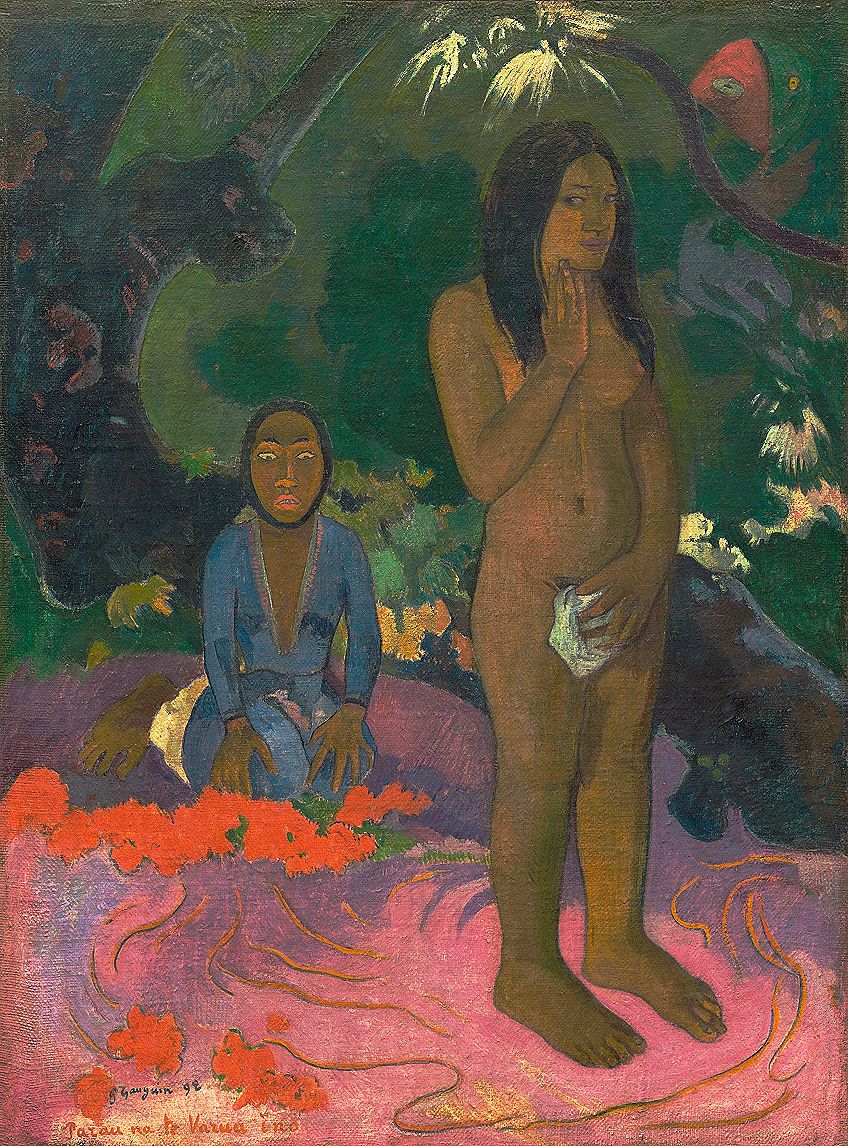 Words of the Devil(1892) past Paul Gaugin, an example of artwork that drew from primitivism;Paul Gauguin, Public domain, via Wikimedia Commons
Amadeo Modigliani was principally influenced by the masks of the Baule inhabitants of the Republic of cote d'ivoire, sketching their middle-shaped outlines and constricted chins, while his workshop colleague Constantin Brancusi noticed parallels between the wooden pieces and his own Romanian sculptures. These basic shapes served equally the foundation for his dramatically basic sculptures.
Primitive art was also adopted by the Dice Brücke and Der Blaue Reiter groups in Deutschland. Franz Marc and Kandinsky showtime observed African sculptures at Berlin's Ethnographic Museum in 1907. Kandinsky, rather than existence motivated by certain shapes, gear up out on a journey to include all artistic manifestations.
"For the Blaue Reiter, 'the primitive' might but equally hands imply children's paintings every bit it could tribal adroitness," art historians fence. The painters of Die Brücke embraced Primitivism fully, not merely appropriating creative forms, merely constructing an entire lifestyle based on the notions connected with Primitivism. In urban center workshops, artists re-created the envisioned milieu of tribal life. In the rural areas, farmers' way of life was valued for its own sake.
During their summer holidays, some painters fifty-fifty ' went native,' living naked with their subjects and enjoying a sexual companionship that mimicked – or so they imagined – the purported innate openness of tribal society. Artists from the Us, like Marius de Zayas, came to Europe and witnessed firsthand the consequence of Primitivist fine art forms on the advanced.
Weber started gathering African sculptures and occasionally put items in still works of art, and de Zayas brought back African pieces for photographer Alfred Stieglitz. Stieglitz made a significant contribution to the early spread of Primitivism fine art in America by displaying works past Brancusi, Matisse, and Picasso alongside African fine art and Mexican ceramics.
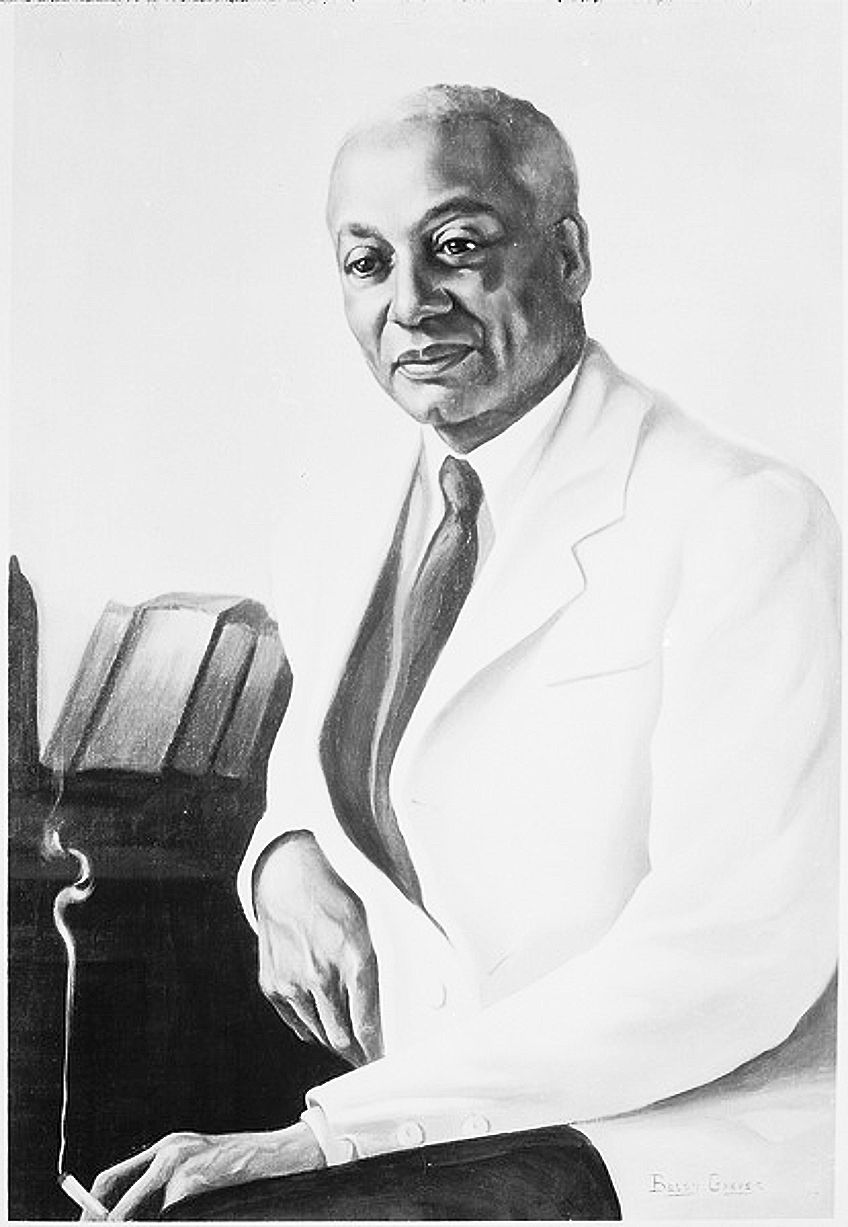 A portrait painting of philosopher Alain Locke past Betsy Graves Reyneau, located in the National Archives at College Park in Maryland, United States;National Archives at Higher Park, Public domain, via Wikimedia Eatables
In the 1920s and 1930s, philosophers such every bit Alain Locke underlined the significance of African American painters drawing inspiration from African fine art. Rather than utilizing forms without regard for their original settings, Harlem Renaissance painters similar Beauford Delaney and Aaron Douglas drew from African history and art and merged their experiments with contemporary avant-garde aspects to establish a new perspective of and for contemporary African Americans.
Surrealist painters later became interested in primitive fine art, albeit they valued Native American and Oceanic art over African Artwork. The Surrealists were more interested in the unseen energies inherent inside early art than they were in its structural advances.
They believed that these primitive societies were more in melody with the spirit realm and provided a model of how to overcome Western materialism and connect it into a universal soapbox through the subconscious.
Primitivism Styles and Concepts
With greater travel and Napoleon's conquest of Egypt in 1798, European painters grew interested in the Eastern civilizations of the Middle E, Asia, and North Africa during the 19th century. In that location was a rising need for products from these nations, including fabrics, ceramics, and fashion. Painters like Ingres and Delacroix showed exotic, and sometimes eroticized, images of harem ladies and ordinary life.
Using brilliant colors, the painters created genuine settings that were either fictitious or a mash-up of numerous aspects, perpetuating Western prejudices of the E.
Orientalism and Primitivism
Orientalism, which is founded in imperialist views, frequently portrays the non-Europeans every bit unenlightened or illogical, justifying European intervention in that culture. Primitivism parallels these early on fixations with Eastern civilizations.
Both are based on a notion of European supremacy and are built via complicated, and sometimes conflicting, appropriation and depiction tactics.
While Orientalism is obsessed with established countries, Primitivism is obsessed with the early on phases of cultural development. In this respect, primitivism entails a return to an allegedly more ideal condition of coexistence with nature.
Naïve Art and Kid Art
Primitivism's popularity coincided with the popularity of kid fine art in many respects. Children's art does not attach to pre-established standards or customary conventions since they lack professional education.
At the start of the 20th century, artists and commentators compared children'due south drawings to primitive peoples' art considering of their purity and instinct.
In 1885, Viennese creative person Franz Cizek stated that children fabricated art with intrinsic artistic worth, and he advocated for free expression and the apply of imagination in educating children. Children'southward drawings were representative of a artistic process that was not disproportionately intellectualized and appeared more straightforward for painters such as Picasso, Matisse, Chagall, Kandinsky, and Klee, who were investigating abstract shapes without any narrative function.
Children'due south artwork, in addition to reconsidering the creative side, attracted artists in their style of experiencing the world. Marc Chagall's fanciful shapes and arrangements were inspired by children's art, and he used familiar and instinctive motifs to create a type of fairytale universe.
Naïve painters were sometimes referred to as "contemporary primitives," highlighting the philosophical foundation of how people perceived their work.
Neoprimitivism
The New York Museum of Modern Art held a large exhibition highlighting Primitivism in 1984. The exhibition featured works by famous European and American painters, ranging from Gauguin through the Abstract Expressionists and more current artists.
The paintings and carvings were shown aslope African, Oceanic, and indigenous works with comparable formal features. While the organizers meant for the exhibit to be a clear examination of which gimmicky artists saw which African and indigenous items, information technology instead sparked a flurry of significant criticisms.
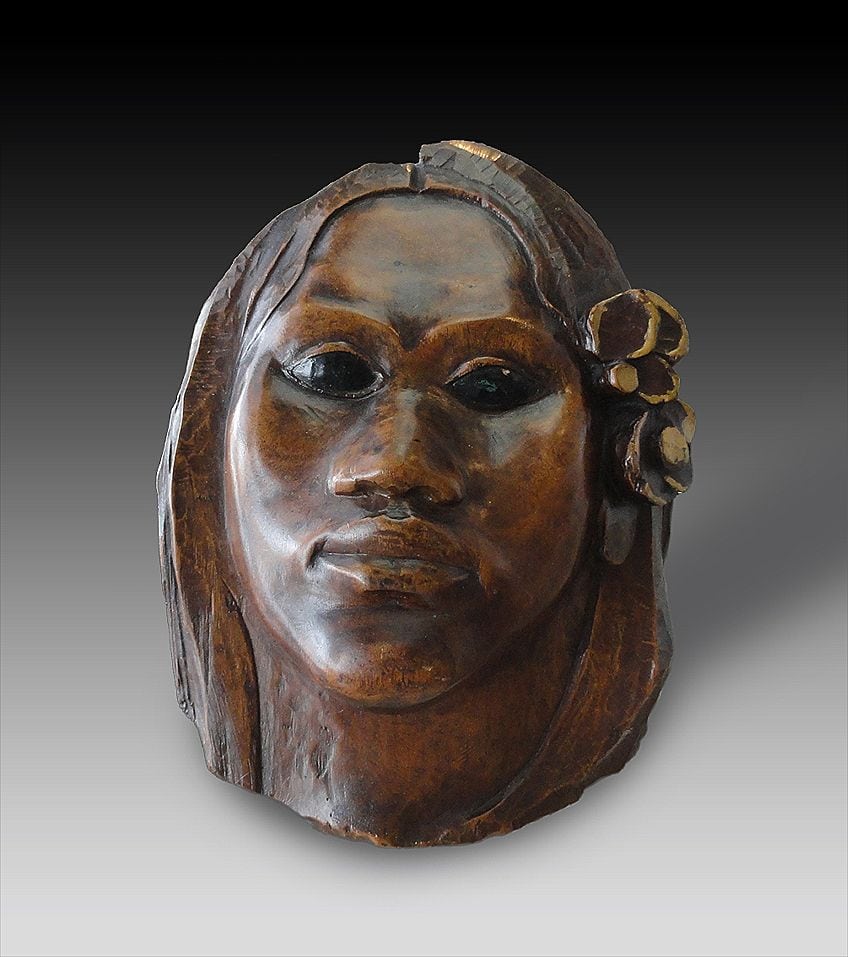 Head of a Tahitian Woman with a Standing Female Nude on the Contrary(c. 1892) woods etching past Paul Gaugin, located at the Musée d'Orsay in Paris, France; Paul Gauguin, CC0, via Wikimedia Commons
The curators, according to the testify'southward detractors, exploited the anonymously sourced and fragmented arts of primitive civilizations every bit easy material for modern artists rather than pieces of art in their own sense. The organizers strictly restricted the audience's encounter of the selected artworks through configuration and incorporating wall texts, according to one of the exhibit's most vocal opponents, Thomas McEvilley.
This was so that the modern European designers were observed as clever and innovative, rather than mere appropriators of other societies' craftsmanship.
Famous Primitive Paintings
At present that we take explored the Primitivism definition and concepts, perhaps we should take a look at some examples of Primitive paintings. These artworks volition help requite united states of america a better agreement of the use of Primitivism in art. Here are some of our favorite examples of Primitive artwork.
Vision Later on the Sermon (1888) by Paul Gauguin
| Date Completed | 1888 |
| Medium | Oil on Canvas |
| Dimensions | 72 cm x 91 cm |
| Electric current Location | Scottish National Gallery |
Gauguin depicts a visionary scenario in which ladies in white bonnets and black robes stand with their backs to the observer, several with their eyes closed and easily joined in prayer, seeing a scenario from the Old Testament, Jacob battling with an angel. Gauguin paints the heavenly vision on a ruby background to signal that information technology is not taking identify in the physical world.
Gauguin and other Symbolists were establishing a new visual linguistic communication at the time, which is reflected in the compressed infinite and simplified shapes. Gauguin equated his composition'southward simple and flattened outlines with the Breton people'southward "primitiveness," as he saw it.
 Paul Gauguin Wearing a Breton Jacket(c. 1891) photograph taken by Louis-Maurice Boutet de Monvel; Louis-Maurice Boutet de Monvel, Public domain, via Wikimedia Commons
Such abstractions have links with both Breton religious activities and Symbolist aesthetic appeal in that they relate to an inner significance rather than outward reality. Gauguin notably depicted Polynesian girls and women in eroticized stances in bathetic vistas and interiors, using these newly discovered shapes and abstractions to portray comparable parts of Tahitian society that he subsequently met.
Before Gauguin's renowned South Pacific voyages and motion to Tahiti to escape the oppressive conventions of civilized, contemporary Paris, he and others sought refuge in Brittany, a rural region of Northwest France known amid painters for the regional practices and traditions continued with peasant life.
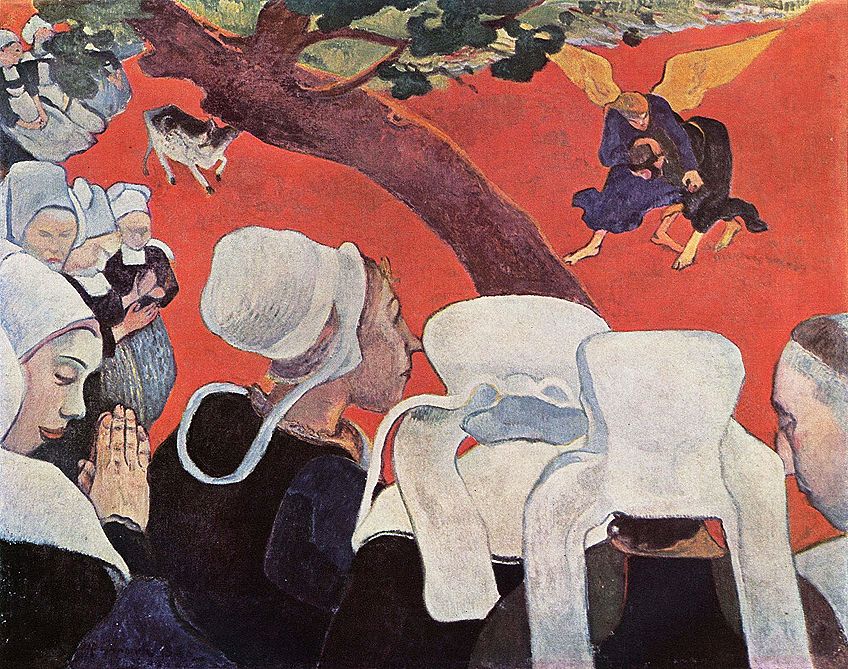 The Vision After the Sermon (Jacob wrestling with the Affections)(1888) past Paul Gaugin, located at the Scottish National Gallery in Edinburgh, Scotland;Paul Gauguin , Public domain, via Wikimedia Commons
Gauguin's primitivism inclinations were fully established in the late 1880s paintings he made in Pont-Aven, according to fine art historian Gill Perry. Gauguin described his visit to Brittany in a alphabetic character to a fellow creative person, "Brittany is ane of my favorite places in the earth. Something central and earliest appeals to me here. I hear the depression, muted forceful sound that I'thou looking for in my picture equally my clogs reverberate on this rocky dirt."
Les Demoiselles d'Avignon (1907) by Pablo Picasso
| Date Completed | 1907 |
| Medium | Oil on Canvas |
| Dimensions | 244 cm ten 233 cm |
| Current Location | Museum of Modern Art |
This primitivist artwork features five naked girls in various attitudes and is one of the almost famous paintings of the 20th century. Most of the women accept their backs to the spectator. Three of them have mask-like faces, and their limbs are geometric and abstract. While the scene is stylized, with hints of a pall and a nevertheless life on a small table in the front, the ladies are clearly in a brothel co-ordinate to Picasso's extensive studies.
Picasso mixes his study of Archaic art, notably African and Iberian sculpture, with allusions to Michelangelo to construct a new synthesis that would have repercussions throughout the 20th century in this pioneering pre-Cubist piece of work.
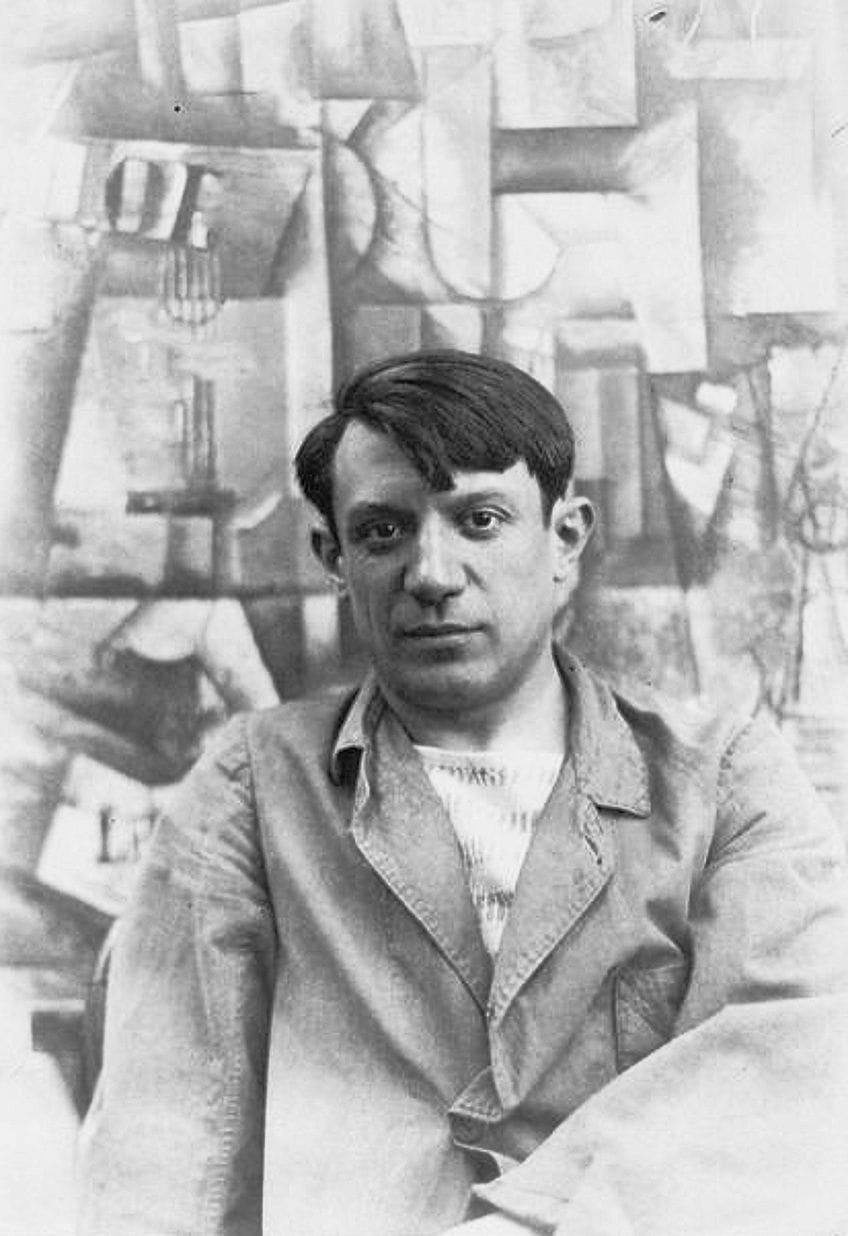 Portrait photo of Pablo Picasso, taken in 1912;AnonymousUnknown author, Public domain, via Wikimedia Eatables
Picasso's imitation of archaic art has gotten a lot of attending. He was already interested in early Iberian art and Romanesque art, and following a talk with Henri Matisse and trips to the Trocadéro Museum in 1906, he started to collect African sculptures for himself.
Picasso remembered in 1937 a revelation he had in 1907 when visiting the Trocadéro. While the museum's scents and layout turned him off, Picasso recalled that when he saw the African artworks and masks, he recognized, "The masks were unlike any other sculpture. Not in the least. They were pathfinders – the Negroes' sculptures – against everything; mysterious, menacing spirits."
Picasso took on the technical aspects of African masks, including oval curved faces and geometric and angular face shape, merely he also took on the notion that the method of producing a piece of fine art may be seen every bit an inherent component of its purpose.
While Picasso was unaware of the meanings and purposes of these masks, when he divers "Les Demoiselles" as his "first sail of exorcism," he related the formalism and mystical characteristics he thought they had to his own creative processes.
Bathers in a Room (1909) by Ernst Ludwig Kirchner
| Date Completed | 1909 |
| Medium | Oil on Canvas |
| Dimensions | 151 cm x 199 cm |
| Current Location | Tate Museum |
Kirchner transposes the customary bucolic, outdoor scene of customary bathers into his workshop, vividly colored and furnished with pseudo-Archaic objects and fabrics, in this large-scale painting. In the center area, tall, dark sculptures adorn the entrance jamb, while a brightly colored mantle divides two chambers on the left. A sitting monarch and an dotty pair may be seen in the roundels on the curtain.
Kirchner had seen African and Oceanic sculptures at the Dresden Anthropological-Ethnographical Museum and was familiar with them.
As art historians point out, the Primitive artifacts, together with the vivid colors, deformities, and contours of the figures, would have suggested a "directly" or "genuine" representation then identified with Primitive, or uncivilized, societies.
In the 1906 manifesto Die Brücke, it is said, "We assemble all young with trust in development and a new generation of producers and watchers. As youth, we bear the potential in us and desire to create freedom of being and motility for ourselves in opposition to long-established elder forces. We embrace as our ain anybody who straight and authentically reproduces what inspires him to create."
The embracing of the Primitive by Die Brücke signaled their hostility to bourgeois ideals and the rapidly industrializing surround, too every bit their mediator between and then-called Archaic thinking and contemporary idea and fantasies.
Childbirth (1944) past Jean Dubuffet
| Date Completed | 1944 |
| Medium | Oil on Canvas |
| Dimensions | 100 cm x 80 cm |
| Electric current Location | Museum of Modern Art |
A lady gives birth to a baby while two bystanders stand by her side in this stunning shot. Dubuffet's rendering of the feminine form is coarse and simple. Her limbs and hands are lifted, and her legs are spread out, while the babe appears between her legs. Dubuffet has angled the bed on which she is lying toward the picture show'south surface, flattening the entire organisation. Dubuffet created art that appeared incompetent and childish.
He looked to examples of Primitive art, as well as work created past children and the mentally ill, to notice an artistic expression that questioned standard Western norms. Dubuffet pioneered the concept of Fine art Brut, often known as raw fine art or "outsider art"; it refers to art, including his own, created outside of academic traditions and past persons who did non regard themselves as artists.
Dubuffet told his audience in a 1951 speech that he believed the art of so-called primitive persons was more advanced than Western art, adding "Personally, I strongly believe in barbaric characteristics such as instinct, emotion, emotion, violence, and lunacy. For myself, I strive for piece of work that has an firsthand link to daily life, art that is a very direct and true delineation of our real lives and feelings." Nevertheless, like many other European painters who accept shown an interest in primitive art before him, Dubuffet fails to recognize the indigenous community and education that were the setting of the work he commended.
Primitivism fine art, a multifaceted and usually contradictory trend, introduced a new way of interpreting and utilizing forms of and then-called primitive artwork and had a vital role in significantly modifying the direction of American and European art around the plow of the twentieth century. Primitivism in art was not so much a school every bit it was a trend amongst several current artists from diverse countries who were looking to the past and other cultures for new aesthetic resources equally urbanization and industrialization expanded. Get-go in the late 19th century, the influx of African, Oceanian, and Native American tribal artworks into Europe presented Primitivist painters with a new visual vocabulary to work with. In many ways, archaic paintings provided artists with a platform to challenge the staid traditions of European art.
Frequently Asked Questions
What are Primitivism Fine art and Neoprimitivism Art?
Archaic art, as regarded by contemporary painters, provided not but new aesthetic forms but also a deeper and more thorough spiritual and emotional template that artists utilized to attack Western culture's industrialization. Primitive paintings, drenched in nostalgia, sought linkages to a pre-industrialized era when people were more continued to the surround and i some other. The long-lasting impact of Primitive paintings, as well equally long-held beliefs almost the low quality of piece of work from colonial regions, accept made information technology difficult to incorporate artists from Africa, America, and the Caribbean in art historical narratives, but efforts to construct a universal art history are underway.
How Did the Idea of the Noble Primitive Arise?
During this time, which many saw equally a decline from earlier periods, the image of the "noble barbaric" was prevalent; civilisation had been corrupted, dominated past people marked by greed, egoism, and a craving for power. The primitivist, who is thought to exist more in touch with nature, was considered as having a better grapheme and being more sympathetic to the modern, immoral man. Individuals, particularly artists, began to protestation against the industrialization and urbanization they experienced equally modernity gained concur. Artists began to investigate other cultures and traditions to combat what they perceived equally restrictive and static Western standards.
morrisonretak1953.blogspot.com
Source: https://artincontext.org/primitive-art/
0 Response to "How Is Primativism an Important Factor in Evolution of Modern Art"
Post a Comment